Survival of the Whitest: Minorities in Horror films
Every genre of film has a rather contentious relationship with its portrayal and treatment of race. The horror genre is no different. In the article “Race is the Past and Future of Horror Movies” K. Austin Collins reasons that, “Horror, the genre known for slashers, ghouls, and possessed baby dolls, could be reimagined as a response to the real-world horrors of something like racial violence”. The key phrase there is could be. Society has never been presented with a large selection of horror films dealing with the intricacies of race or racism, and even the ones that are available seem to fall flat in their treatment of the subject.
In The Shining (Stanley Kubrick, 1980) Kubrick prominently features only one black character, but it still seems to say quite a great deal about race. Before the audience is even introduced to Mr. Hallorann, it is made apparent that the Overlook Hotel itself owes its existence to overt acts of racism. In an early scene, Wendy and Jack are proudly told by the hotel manager that the Overlook was built on an Indian burial ground and that during the building’s construction there were fights to fend off attacks from the local Native American populations. The mere presence of the hotel informs the audience who the victor of those fights was. In an article for the website, the Artifice, Robert Humphrey writes that Kubrick is “using American history to show the racism ingrained in the Overlook”. Later in his essay, Humphrey also argues that Hallorann, played by Scatman Crothers, is the only positive adult male figure in the film, but even as such, he is still subject to racism from the other characters. During one of Jack’s interactions with the hotel’s old caretaker, Grady, Hallorann is referred to as “the Ni**er cook”, in a show of overt racism and classism as Halloran’s job as a cook is used to diminish his social standing.
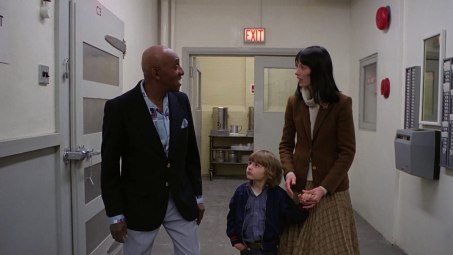
Aside from Wendy, Hallorann appears to be the only one who is concerned about Danny’s wellbeing while he and his family are staying in the hotel. He immediately takes the boy under his wing as he explains their shared psychological power “shining” and eventually warns Danny to stay away from room 237. When Hallorann senses that something is amiss at the hotel he even abandons his Floridian vacation to fly back to snowy Colorado and makes the long journey to the Overlook to check on Danny and Wendy. Unfortunately, when he finally makes it inside of the hotel, Hallorann becomes the film’s first onscreen causality and the only victim of Jack’s murderous rampage. Despite the connection that is established between Hallorann and Danny, his death is rather unceremonious, no one mourns his loss. In fact, Hallorann’s corpse is hardly acknowledged and it seems his only purpose was to provide Danny and Wendy with a vehicle of escape.
Although, perhaps not Kubrick’s intended take-away from the film, for minority audiences, the lesson seems to be that even the most well-intentioned black and brown characters aren’t safe from the horrors lurking about the screen. The best course of action to ensure survival is to avoid involving oneself in the problems of white people.
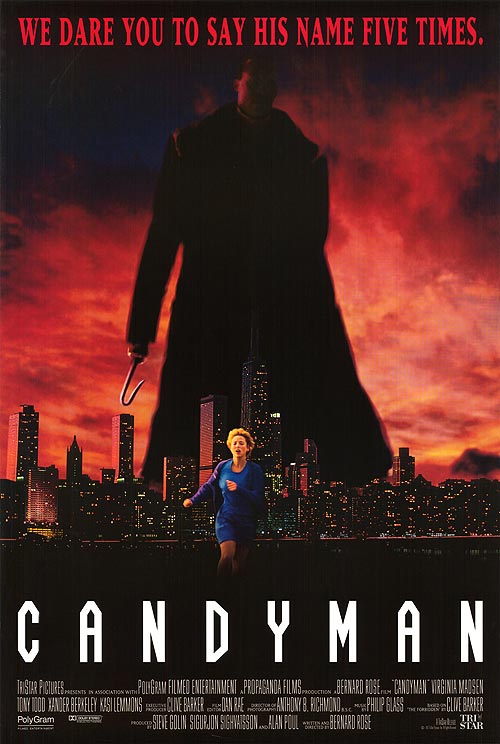
While The Shining warns minorities to keep away from white people, lest they become swept into unforeseen peril, the film Candyman (Bernard Rose, 1992) depicts minorities in a very different way. In the article, “Black (Fear) On Both Sides: Thinking About Race in Horror Films” Ashlee Blackwell discusses the treatment of race in a few horror films throughout history. Referring to the book Horror Noire: Blacks in American Horror Films from the 1890s to Present by Dr. Robin Means Coleman, Blackwell discusses the difference between black people in horror films and black horror films, “Blacks in Horror Films make suggestions about where an audience places the horrifying, usually within the racial other (Candyman). Black Horror Films depict horrifying social inequalities and personas as monstrous, with Black, centralized protagonists unmasking racist tropes and exercising empowerment (Blacula)” (Blackwell). Candyman aims to examine societal views of race, but just ends up enforcing the stereotypes it aims to subvert.
When Candyman’s name is said into a mirror, according to the legend, he appears and disembowels the speaker with his hook hand. Near the beginning of the film, Helen does exactly that and speaks Candyman’s name into her bathroom mirror, so why is it that it takes the entirety of the film for Helen to receive her due punishment? And why are the black people around Helen also made to suffer the consequences of her transgressions?
In D.W. Griffith’s infamous film, The Birth of a Nation (Griffith, 1915), one of the white female protagonists throws herself off of a cliff to avoid the advances of a black man. This societal fear of miscegenation has been the cause of countless disgusting crimes against black people and this fear leads to the death of Daniel Robitaille, the black man who becomes the titular Candyman. Robitaille’s tragic backstory obviously serves to humanize his character, but it also illustrates the outcome of a disgusting act of racism. White fear of an interracial union ironically leads to even more destruction in the late 20th century as the Candyman terrorizes the citizens of Chicago. Later in the film we learn that Candyman is murdering people, including Helen’s friend Bernadette, and kidnaps a baby in order to convince Helen to join him in the afterlife. So, on one hand the film illustrates the horrors of and condemns racism but on the other hand it reinforces the idea that a black man’s lust for a white woman has the potential to cause societal destruction and turmoil.
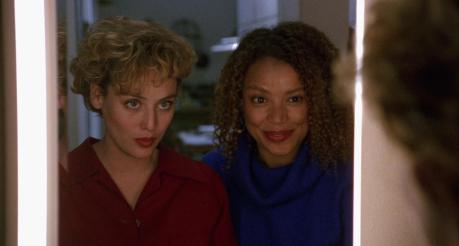
That being said, in the article “‘Race Is the Past and Future of Horror Movies” K. Austin Collins argues that Helen is the true monster of the film. Collins asserts that, “The movie makes a point of marking Helen as a figure of black displacement. The building she lives in, originally intended to be the sister structure Cabrini-Green, was instead fashioned into expensive condos for educated whites; yet, as she notes, the outlines of the buildings are the same. In a way, what happens to Helen comes off in the movie as karmic punishment — for being white”. I don’t agree that Helen is being punished for her whiteness, the brown people around her specifically Bernadette and Anne-Marie, are made to suffer long before Helen receives any real consequences. Helen is arrested and committed to a psychiatric hospital, but Bernadette is brutally slaughtered, and Anne-Marie is forced to deal with the disappearance of her only child, the only thing either of these women has done wrong is to have been associated with Helen.
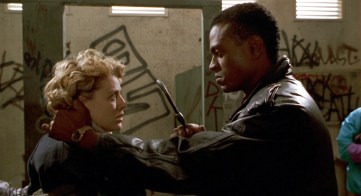
I do, however, agree with the view of Helen as a destructive force in the black community. In the article, Collins goes on to say that “[Helen] isn’t merely hunted by the Candyman: He possesses her body and has her kill on his behalf, causing a ruckus in the Cabrini-Green apartments that attracts police attention to the detriment of the black residents. He exacerbates her privilege. She becomes their nightmare”. From the moment Helen arrives at Cabrini-Green the residents are put on edge. Her whiteness is unwelcome in their space and causes tension amongst the residents because they initially believe that she is a police officer. At a later point in the film the young black boy, Jake, remarks that Helen isn’t like the other white people who come to the apartment complex. It can be assumed that he is referring to police, social workers, or other government officials who in his eyes are there to hurt the residents rather than help them. But during Helen’s time in Cabrini-Green Anne-Marie’s dog is dismembered in her apartment and her baby is stolen from her, bringing grief and attracting an increase in unwanted police presence in the area. Ultimately, though, the film seems to undermine this position with the redemption of Helen’s character in the last scenes of the film. She saves Anne-Marie’s baby (from danger he was put in because of Helen) before perishing along with the Candyman in a large fire. At her funeral Helen seems to be sainted in the eyes of the black community as tons of black people form a long procession, Anne-Marie and Jake leading the way, to pay their respects at her grave, disregarding all of the problems she created for them.
It has become somewhat of a joke in present day society that if there are black people in horror films, they will be one of the first characters to die. As crass as it may be, at least blacks are included, if only via the joke. Other ethnic minorities; Asian Americans, latinx people, and Native Americans, are rarely seen in horror. In today’s cinema slowly but surely the horror genre is becoming more diverse and hopefully with added diversity audiences will be allowed to experience minorities depicted in ways other than as victims of white transgressions and ill-fated interventions.
image sources: https://www.imdb.com/title/tt0103919/mediaviewer/rm1450991360, https://www.imdb.com/title/tt0103919/?ref_=nv_sr_srsg_3
 Did you see that? Did you hear that?
Black inclusion has been a perpetual problem in the US in many forms of media. There has been some inroads within the genre of horror of late.
LikeLike