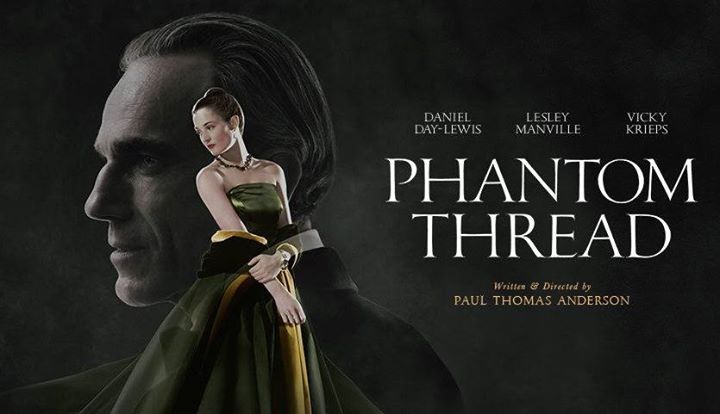
The Phantom Thread
As this is the first review I am writing for this blog, I find it appropriate to provide a brief explanation of how I am going to approach them. (Feel free to skip this portion if it is of no interest to you, but just know you can’t say I didn’t try to help you.)
In my reviews I am likely to linger on any topic that interests me be that the casting decisions, the genre classifications, unexpected twists, or any other element of a piece. I would also just like to say this now: THERE WILL BE SPOILERS! I am sorry, but I just can’t help myself, I will try to do an initial overview and ending summation + the review itself without revealing any important information and I’ll do my best to warn you before I reach the point of no return. I would also just like to add that summaries, by nature lack excitement (in both their reading and writing) and are never anywhere near as good as an actual piece of media so please don’t be put off by the fact that I will chose to keep mine brief. It is also important to note that these will read as more of an amalgam of review and analysis depending on the piece.
Those are all of the forewords I’m going to provide (enough beating around the bush!). So, without further ado, here is my review/brief analysis of the Phantom Thread.
The Phantom Thread is a 2017 feature film with a two-hour and ten- minute run time, written and directed by Paul Thomas Anderson. Oscar winning actor, Daniel Day-Lewis occupies the starring role of Reynolds Woodcock, a highly celebrated and meticulous dressmaker. Lesley Manville plays Cyril, the sister of Reynolds Woodcock, and Vicky Krieps is tasked with a portrayal of Alma the mysterious and strong-willed muse and love interest of Reynolds. The film follows the progression of the interesting and volatile relationship between Alma and Reynolds. The film is brightly lit and beautifully shot, the score is well suited to the subject matter and isn’t oppressive, overwhelming, or distracting to the scenes (see: Baby Driver) allowing the viewer to focus on the intricate costuming and set design as well as the subtle development and transformations that occur in certain characters.
From This point on I can’t guarantee the absence of spoilers; sorry kids.
One of the first and most pervasive questions i had while watching this film stemmed from trying to decipher the nature of the relationship between Cyril and Reynolds. Initially I wasn’t sure if she was his mother or his wife, then after discovering that Cyril is the sister of Reynolds I remained convinced for approximately half of the film that there was a secret incestuous relationship between the two. This is not the case, but it indicates a much larger theme that can be spotted throughout the film. It does appear that although Reynolds is in charge of his business and holds tightly to the reigns, he is, at the same time, far too dependent on the women around him.
When writing this screenplay Paul Thomas Anderson must have missed the memo that the grown man with “mommy issues” trope is entirely too played out in Hollywood (Norman Bates called, he wants his brand back). Reynolds is borderline obsessed with his late mother, who he talks to and idolizes, and he even sees her (decidedly uninteresting and uninterested) ghost while he fights a bought of severe sickness.
I would actually like to briefly harken back to Norman Bates (the titular character of Alfred Hitchcock’s 1960 film: Psycho, in case the reference is unfamiliar). Bates and Woodcock are similar because of their obsessions with their mothers post mortem, but also because both characters are more effeminate than typical male characters. Both men have tall thin body types, additionally, Bates is soft spoken and not particularly threatening, and Woodcock makes beautiful women’s dresses (Not to mention the perhaps coincidental similarity between Reynold’s surname of Woodcock and the last name of Psycho’s director Hitchcock, though this admittedly may be a bit of a stretch). With these similarities made apparent, it would stand to be predicted that Woodcock is, much like Bates, actually the sinister villain of the film. For a while it does appear as though this is the case, Reynolds grows increasingly severe and impatient towards Alma even going so far as to ask Cyril essentially to break up with Alma on his behalf. But in an unexpected reveal, it is the quaint and charmingly outspoken Alma who wreaks havoc on Reynolds.
Throughout the film it is difficult to watch Alma get subjected to the outlandish demands and childish moodiness of Reynolds when she herself does not appear to commit any offence other than being too loud during breakfast. But when Alma feels Reynolds is not appreciative enough of her, she makes the definitely-not-crazy at all decision to put poisonous mushrooms in his food. The mushrooms result in Reynolds growing miserably ill, at which point Alma takes care of him, tending to his needs and nursing him back to health. It is grossly apparent that Alma aches for Reynolds to need her, she describes loving him while he is in vulnerable states, when he is delicate “like a baby” because she loves the opportunity to exert total control over him (as convoluted as her plan seems, it greatly strengthens their relationship, Reynolds does in fact realize that he needs Alma, and the pair gets married, not quite sure what the message there is supposed to be…). It is revealed near the end of the film in an unexpected twist that Reynolds is aware that Alma is poisoning him, and he actually wants it to happen because he desires to be incapacitated so that she can care for him (I would have just recommended couples therapy, but what do I know).
I can honestly say that I never expected to be as shocked and baffled by this film as I was, and I still don’t know how I feel about it. Nevertheless, the film is an interesting examination of power dynamics and control within relationships.
TL; DR: I personally felt every single second of the film’s rather cumbersome runtime, but the beautiful sets, locations, and costumes, complimented by well utilized bright natural lighting, may counteract this for some viewers (big emphasis on some). Interesting characterization and unexpected plot points also add to the film’s “watch-ability” but I am inclined to recommend this film for patient lovers of period pieces and slower more subtle stories.
 Did you see that? Did you hear that?
Yeah, this makes me want to see the film even more now. I didn’t mind the spoilers (I’ll see a film either way). Really good review and interesting comparison with Norman Bates and Woodcock.
LikeLiked by 1 person