Revenge of the Outsiders
“Here’s a misfit, a social outcast who wants nothing more than love and acceptance and faces extraordinary obstacles to get it,” she says. “There’s a reason why queer audiences identify with the misfit and the social outcast…” (Kimberly Pierce, “Queer as Carrie”). In this quote from Kimberly Pierce, the director of the most recent iteration of the film Carrie, is referring specifically to queer audiences but her comment can be applied to any group of people who have been relegated to the outer dimensions of society. Characters who aren’t accepted by society are easy to relate to. There is no person living who at some point has not wanted to be accepted by their peers, loved by their family, or embraced as part of some kind of community, this is what makes otherized characters so compelling.
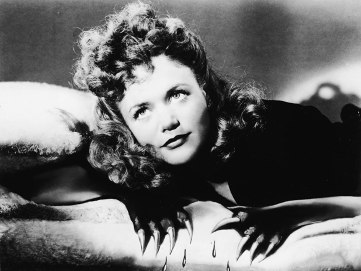
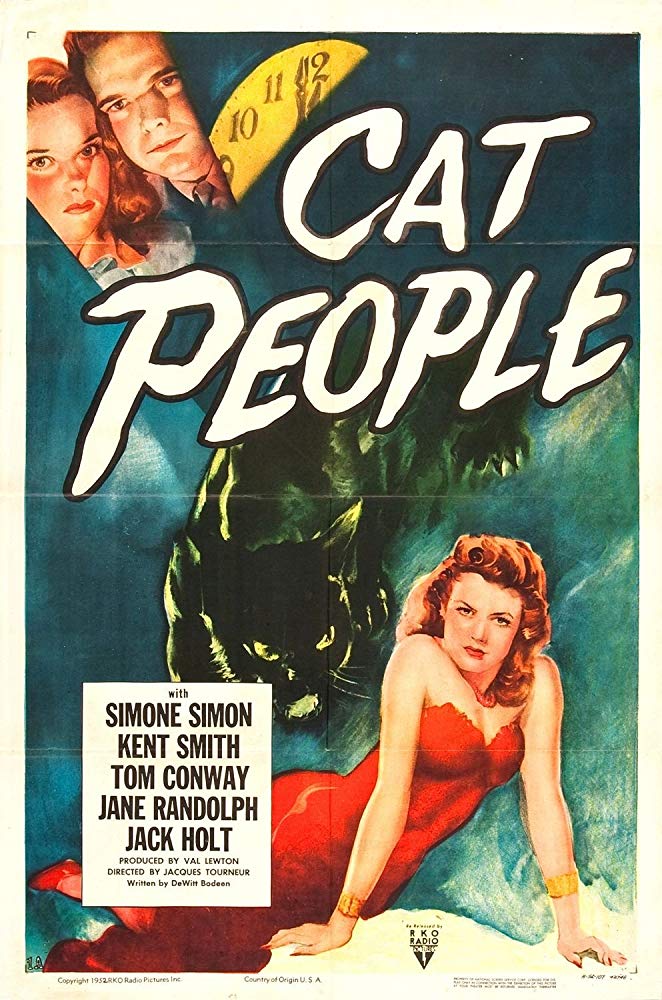
The alienation of the protagonist in horror films, usually due to circumstances out of their control, adds relatability and makes them all the more sympathetic. Cat People’s (Jacques Tourneur, 1942) Irina, is a foreigner with a thick Serbian accent living in 1940s America. She is made to feel even more strange due to her husband, Oliver’s criticism and eventual dismissal of her beliefs and heritage. When Irina tells Oliver about the cat people from her homeland, he takes her by the shoulders and, looking down at her like a parent scolding a child, tells her that they are simply fairy tales. On the night of their wedding, the distance between the couple is illustrated with a shot of Oliver standing outside of Irina’s bedroom door then a cut to the other side where Irina sits on the floor leaning against the door because despite her desire for Oliver, she is unable to be with him for fear she might transform. After they are married, Oliver sends Irina to a therapist to have her “delusions” cured in order to try to salvage their relationship. Carrie White is also criticized and even tormented because of her strange beliefs, or rather because of knowledge she lacks. Carrie’s (Brian De Palma, 1976) opening scene reaches its climax with Carrie’s classmates’ brutal mockery because she doesn’t know anything about menstruation.
Both of these films also involve the “outsiders” being held responsible for the unhappiness of those around them, adding to the isolation of the protagonists. Carrie’s mother tells her that she is the product of rape, so her mother is convinced that she was sent by Satan to punish her for her sin of premarital sex. Irina is also directly blamed for the unhappiness of her husband who in discussing their marriage with Alice says, “You know, it’s a funny thing. I’ve never been unhappy before. Things have always gone swell for me” (Cat People). Oliver is a conventionally attractive heterosexual white male who in his own words is a “good plain americano” which makes Irina’s foreign-ness even more blindingly obvious. Oliver is, in fact, so American that every time he visits the diner, he orders a slice of good ol’ American apple pie.
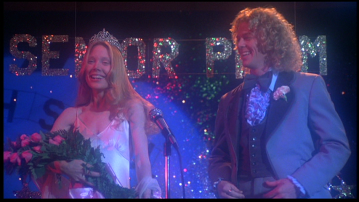
To make things more obvious, Irina’s wardrobe consists of only black garments which contrast very strongly with Oliver’s light-colored outfits, indicating even further that she is nothing like the rest of the film’s characters. Carrie too is juxtaposed against both her school bully Chris, who is beautiful, popular, and sexually experienced, as well as Tommy Ross, Carrie’s prom date who is a typical tall, blonde, athletic all-American boy. Both of these characters offer obvious counters to Carrie’s inexperienced outcast persona. Even Carrie’s house stands out among the others. Sue’s family lives in a stereotypically perfect home with a large well-manicured lawn, nice landscaping, and fresh paint on the outside while the White’s home looks more like a haunted house, it is rundown and old on the outside and the inside is poorly lit and shadowy, decorated with simple but dated décor with religious artwork covering the walls. The film Ginger Snaps (John Fawcett, 2000) seems to go out of its way to establish the film’s two main characters as anti-mainstream. Both Ginger and Brigitte are death-obsessed goths while their parents, especially their mother, are almost cartoonishly “normal” with their boisterous and bubbly mother wearing bright makeup and pink ribbons in her hair.
The characters are so drastically otherized, that they are either called evil or made to feel as such. Quite early in the film, Carrie’s mother uses bible verses to imply that Carrie is evil because women are corrupt and are cursed with menstruation as punishment for their sins. The zoo caretaker in Cat People warns Irina that panthers are “evil creatures”, since the panther at the zoo relates directly to Irina, the implication is that Irina has some kind of evil that is inside of her because of her condition. And as Ginger’s lycanthrope virus progresses its takeover of her body, she experiences increasingly violent impulses that become more difficult for her to control.
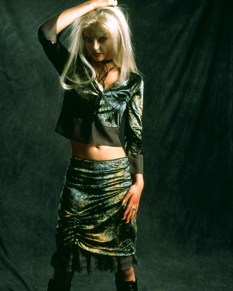
Almost all films provide some kind of catharsis for the audience members and horror movies are no different. For viewers who identify as outsiders, the reversal of the typical predator-prey relationship makes bloody revenge fantasies even more exciting to watch. In films of any genre there is often romantic relationships with men relentlessly pursuing women, but Ginger Snaps turns that trope on its head. Once Ginger begins to be infected by the lycanthrope virus, she embraces her sexuality and even becomes somewhat of a sexual predator. After she is infected Ginger dresses differently, wearing tight figure-hugging outfits accompanied by a greatly magnified sense of self confidence. Ginger is extremely assertive when she has sex with Jason for the first time and though she doesn’t have any prior sexual experience, she pins him down and takes on a dominant role. Later in the film as she grows even more unhinged, Ginger’s desires even lead her to ignore the denial of her advances from Sam and she forces herself on him until he manages to fight her off. While not anywhere near to the same extent as Ginger, Irina is also more active in pursuing a relationship than a typical woman in the 1940s. She is mysterious, charming, and hospitable and even invites Oliver into her apartment where they spend the entire evening together the very first time they meet. As Cat People progresses, Irina also begins to behave in an increasingly predatory manner, she watches Oliver as he sleeps and observes his movements like a cat watching a mouse. The scene where Irina is following Alice as she walks home at night is a clear example of Irina stalking and intimidating her “prey” and romantic rival. The quick cross cutting between Irina and Alice, the absence of music, and the sharp echoing footsteps monumentally increase the scene’s tension and as Alice’s pace quickens the audience also becomes more anxious.
The reversal of these typical relationships provide “otherized” viewers with a sense of satisfaction because marginalized groups of people are constantly cast aside and underestimated by mainstream society. Though she is an independent adult woman, Oliver treats Irina like a child and even frequently calls her “kid”. He speaks to her in condescending tones, disregards her concerns about her condition, and discusses details about their relationship and Irina’s personal life with his friends with no regard for Irina’s feelings. When she is talking to the principal about her accident, Carrie is repeatedly called by the wrong name despite her correction of the mistake. Additionally, whenever Carrie is in the presence of other people, she hunches her shoulders and makes herself smaller, taking up less space and adopting a submissive aura. This can be seen when Tommy asks Carrie to the prom in the library, as Tommy occupies the power position on the right side of the frame, Carrie shrinks away from him like a frightened animal. In Carrie’s first scene with her mother, there is a high angle shot from over the shoulder of Carrie’s mother looking down at Carrie who sits slouched in a heap on the floor at her feet as she is berated with bible verses, this angle solidifies the power structure in the White household implying that Carrie is weak and subservient to her mother. But, after Carrie burns down the school as she is walking home her figure takes up most of the frame, Carrie has now used her powers to silence her bullies, so she is no longer afraid to occupy space and dominate the screen.
There are many types of people who love horror movies, but the most interesting groups may be the last people we think about. People who see themselves as outsiders to society’s mainstream love horror films and for good reason. Horror movies can have protagonists who are against the “norm”, giving viewers characters who are easy to relate to. In films like Carrie, Ginger Snaps, and Cat People viewers who consider themselves to be societal outsiders garner even more pleasure from the satisfying revenge taken by the protagonists against their tormenters and oppressors. Almost everyone has encountered a bully or someone who has made them feel small and unimportant, and whether we want to admit it or not we have all dreamed of what it would be like to get some sweet sweet revenge.
Image source: https://www.imdb.com/title/tt0034587/mediaviewer/rm783994368, http://lifebetweenframes.blogspot.com/2014/09/dirty-pillows-in-house-of-st-sebastian.html, https://www.imdb.com/title/tt0210070/mediaviewer/rm3076331776
 Did you see that? Did you hear that?
Leave a comment